The phrase “clinically validated” on a wearable or home gadget tells you that the maker believes some test in people supports it. It does not tell you what was tested, against what, in whom, or whether anyone outside the company checked. In the United States, the words with regulatory meaning are different ones: general wellness, cleared, granted and approved. Knowing which applies to a device tells you who, if anyone, reviewed its accuracy before it reached the shelf.
Most gadgets are general wellness products
The FDA's policy for low-risk wellness products was most recently updated in a guidance issued on January 6, 2026, which supersedes the 2019 version [1]. It defines general wellness products as products that are intended only for general wellness use and present a low risk to users. The first category of wellness uses covers claims such as physical fitness, relaxation or stress management, mental acuity and sleep management that make no reference to any disease or condition; among its examples are claims to “log, track, or trend exercise activity” and to “track sleep trends” [1].
For these products, the FDA's device center says it does not intend to examine whether they are devices, or whether they comply with device requirements including premarket notification [1]. In practice, that means no FDA review of accuracy before sale. The guidance is explicit about what inclusion means: “A product's inclusion under the general wellness policy in this guidance does not establish that it has been shown to be safe and/or effective for its intended use” [1].
The 2026 version adds detail that matters for wearables. It says products using non-invasive sensing, such as optical sensors, to estimate physiologic values like oxygen saturation or heart rate variability may be general wellness products when the outputs are intended solely for wellness uses, provided, among other conditions, that they do not include values that mimic those used clinically unless validated [1]. It also lists things that take a product out of the wellness category, including claims of clinical equivalence, clinical accuracy, or “medical or clinical grade,” and claims of substitution for an FDA-authorized, cleared or approved device [1].
Cleared, granted, approved: the FDA pathways
A product that is a medical device and is not exempt reaches the market through one of several pathways, each with its own verb.
| Pathway | What the FDA decides | The right word |
|---|---|---|
| Premarket notification, 510(k) | Whether the device is substantially equivalent to a legally marketed device (the predicate): same intended use, and the same technology or different technology that raises no different questions of safety and effectiveness [2] | Cleared |
| De Novo classification request | A pathway for novel devices with no legally marketed predicate, where general controls, or general and special controls, provide reasonable assurance of safety and effectiveness. A granted De Novo device can then serve as a predicate for later 510(k)s [3] | Granted |
| Premarket approval (PMA) | For class III devices; the FDA calls PMA the most stringent type of device marketing application [4] | Approved |
So a 510(k) device is “FDA cleared,” not “FDA approved.” The distinction is not pedantry: clearance says the device is substantially equivalent to a predicate for a stated intended use, and it covers that use only. The FTC's health products guidance gives an example of a marketer whose device was cleared for one narrow muscle-related purpose and whose infomercial then repeated that it was “FDA Approved” alongside dramatic claims the clearance did not cover; the FTC calls that juxtaposition deceptive, because it suggests the FDA found the product effective for those claims [7].
“FDA registered” is not a review
Medical device facilities register their establishments with the FDA and list the devices they make. The FDA's own consumer page is blunt about what that means: the resulting entry in the registration and listing database “does not denote approval, clearance, or authorization of that facility or its medical devices,” and the FDA “does not issue any type of device registration certificates” [5]. A badge that says “FDA registered” or “FDA certified” is therefore not evidence that anyone at the FDA looked at how accurate a device is.
What a clearance record looks like: the FDA's 510(k) database entry K211498 lists the Nonin OTC Pulse Oximeter Model 3250, product code OLK (pulse oximeter for over-the-counter use), decision “substantially equivalent” on November 13, 2024. Its indications for use describe measuring and displaying SpO2 and pulse rate “for medical use without a prescription,” and the linked summary names the predicate (the Masimo MightySat OTC, K214115) and reports the accuracy testing behind the submission. FDA 510(k) database, viewed Sep 30, 2026 [6].
How to look up a device yourself
The FDA's databases are public and free. For a clearance claim, the check takes a few minutes.
Find the number or the maker
Look on the box, manual or product page for a 510(k) number (a K followed by six digits) or a De Novo number (DEN followed by digits). If there is none, note the manufacturer's legal name.
Search the database
Enter the number or the applicant name in the FDA's 510(k) premarket notification database, or in Devices@FDA, which covers cleared and approved devices. For novel devices, search the De Novo database [5][8].
Match the device name and model
Check that the record names this model, not a sibling. Brands often reuse a family name across products with different clearances.
Read the indications for use
The clearance covers what the indications say: the quantity measured, the population, the setting and whether a prescription is required. A marketing claim beyond that is not covered by the clearance.
Open the summary
Most records link a summary PDF that describes the testing, often including the reference method and the accuracy figure. That is where a “clinically validated” claim can be checked against actual numbers.
Sometimes the search does not settle the question, and it is worth saying so. For the Braun ThermoScan 7 in our cabinet, an openFDA query of 510(k) records with “ThermoScan” in the device name on Sep 30, 2026 returned 13 records for other ThermoScan models, such as the ThermoScan 3 (K161933) and the ThermoScan PRO 6000 (K152748), but none under the ThermoScan 7 or IRT6520 name [8]. That does not show the thermometer is uncleared; it shows we could not match a record to it by name. In that situation we report exactly that, and do not print a K-number we could not tie to the product.
What the FTC expects behind a claim
FDA status is only half the picture. The Federal Trade Commission polices advertising, and its Health Products Compliance Guidance (December 2022) applies to health-related claims for any product, including devices and apps [7]. The core standard is that health claims need “competent and reliable scientific evidence,” which the FTC defines as tests, analyses, research or studies that have been conducted and evaluated in an objective manner by qualified experts and that are generally accepted in the profession to yield accurate and reliable results [7].
The guidance says randomized, controlled human clinical trials are the most reliable form of evidence and are generally the type experts would require for health benefit claims. It also says that when an ad claims a specific level of support, such as “clinically proven,” the advertiser must have evidence of that level [7]. A “clinically validated” stamp is therefore a claim about evidence, and the evidence should exist and match it.
For wearable heart rate there is also an industry benchmark: the Consumer Technology Association's standard CTA-2065, announced in 2018, defines performance criteria and a test protocol for consumer heart-rate monitoring [9]. A maker that has tested to it can say so and share the results.
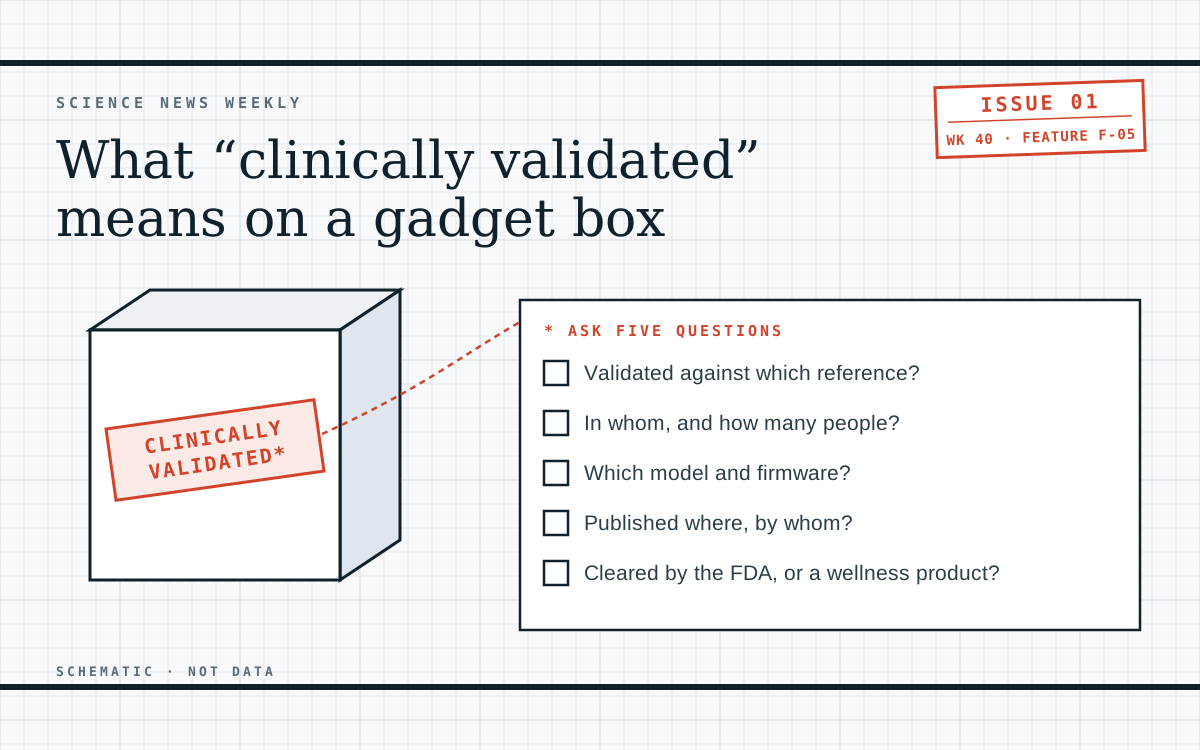
Five questions to ask of a claim
These are the questions on this feature's cover, and they are the questions our instrument entries try to answer for every device.
- Validated against which reference? An ECG, a sleep-lab recording, arterial blood samples or observed steps, or just another consumer device? See What a Wearable Validation Study Actually Measures.
- In whom, and how many people? Ten healthy volunteers and several hundred adults of varied ages and skin tones are not the same evidence.
- Which model and firmware? A result for last year's model, or for a sibling product, is not this product's result.
- Published where, and by whom? A peer-reviewed paper or an FDA summary can be read and checked; a percentage on a product page usually cannot. Note who paid for the study.
- Cleared by the FDA, or a wellness product? Look for a K-number or DEN number and check it. If there is none, assume the accuracy was not reviewed by the FDA, which is normal for fitness gadgets and fine for fitness use.
Our instrument entries apply these questions device by device: the Nonin TruO2 (Model 3250) has a clearance record to check, while the wrist wearables in our cabinet are sold as wellness products, not medical devices.
Even an FDA-cleared device is cleared for a specific intended use, and a wellness gadget is not reviewed for accuracy at all. Consumer gadgets are not diagnostic devices. If a reading from any device worries you, talk to a clinician rather than acting on the number alone.
Sources
- U.S. Food and Drug Administration. General Wellness: Policy for Low Risk Devices, guidance issued January 6, 2026 (supersedes the September 27, 2019 version). fda.gov (PDF) · guidance page
- U.S. Food and Drug Administration. Premarket Notification 510(k), content current as of August 22, 2024. fda.gov
- U.S. Food and Drug Administration. De Novo Classification Request. fda.gov
- U.S. Food and Drug Administration. Premarket Approval (PMA). fda.gov
- U.S. Food and Drug Administration. Are There “FDA Registered” or “FDA Certified” Medical Devices? How Do I Know What Is FDA Approved? fda.gov
- U.S. Food and Drug Administration. 510(k) Premarket Notification database record K211498, and the linked clearance letter and summary. accessdata.fda.gov · summary (PDF)
- Federal Trade Commission. Health Products Compliance Guidance, December 2022. ftc.gov
- U.S. Food and Drug Administration. 510(k) Premarket Notification database, and openFDA 510(k) records searched for “ThermoScan” in the device name, Sep 30, 2026. accessdata.fda.gov · api.fda.gov
- Consumer Technology Association. CTA Announces Standard to Improve Heart Rate Monitoring in Wearables (news release), May 2, 2018. cta.tech
This feature is educational and is not medical or legal advice. Consumer wellness gadgets are not diagnostic devices. If a reading worries you, or you have symptoms, talk to a qualified clinician.