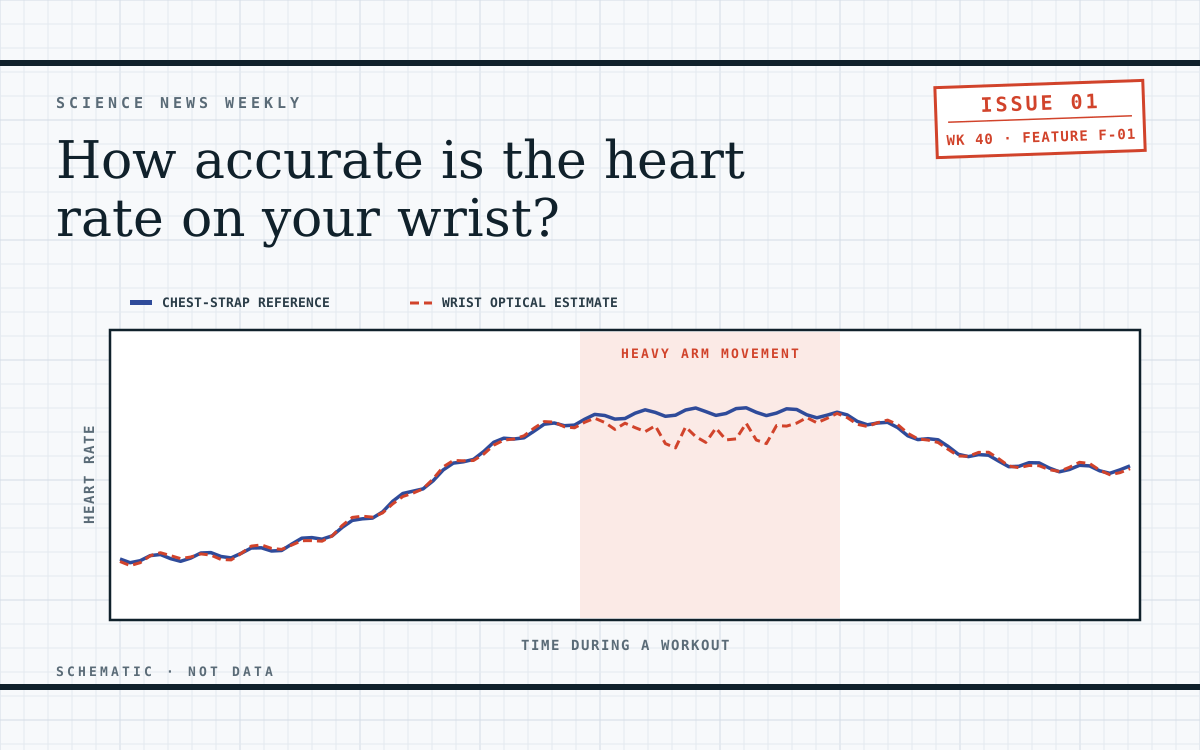
Short answer: at rest and during steady activity, most wrist trackers tested in published studies land close to an electrode reference. When the arms move hard, when intensity changes quickly, or when the band sits loose, the error grows, and it grows by different amounts for different devices. The number on your wrist is an estimate built from light and software, and the studies below show where that estimate holds and where it slips.
How a wrist sensor turns light into a pulse
The method is called photoplethysmography, usually shortened to PPG. LEDs on the underside of the tracker, most often green, shine into the skin. A photodiode next to them measures how much light comes back. With each heartbeat, a small surge of blood widens the tiny vessels under the sensor, and more blood absorbs more light. The returning signal therefore rises and falls once per beat, and the tracker's software counts those oscillations to estimate beats per minute.
That signal is small. Everything else that changes the light path also shows up in it: the band sliding a millimeter, tendons flexing when you grip something, ambient light leaking in at the edge. A 2020 study in npj Digital Medicine grouped the main sources of PPG error into three areas: skin type, motion artifacts, and what the authors called signal crossover, where the sensor locks onto a repeating motion such as your walking or running cadence and reports it as the heartbeat [1]. Most trackers also carry an accelerometer, and the algorithms use it to try to subtract motion from the optical signal. How well that subtraction works is a large part of why devices differ.
A chest strap works differently. It carries two electrodes that sit against the skin and pick up the heart's electrical activity directly. There is no light path to disturb, so arm movement matters much less. That difference in physics explains most of what follows.
What studies found at rest and during exercise
The npj Digital Medicine study put four consumer wrist wearables (including the Apple Watch 4 and the Garmin Vivosmart 3, an older predecessor of the band in our cabinet) and two research devices on 53 adults, with an electrocardiogram (ECG) patch as the reference. The protocol ran through seated rest, paced deep breathing, walking, a second rest and a typing task. For the consumer devices, mean absolute error averaged 7.2 ± 5.4 beats per minute at rest and 10.2 ± 7.5 bpm during activity; across devices, absolute error during activity was on average 30% higher than at rest [1]. The authors concluded that the devices were reasonably accurate at rest and during prolonged elevated heart rate, but differed in how they responded to changes in activity.
A Cleveland Clinic team tested optical monitors on 50 healthy adults on a treadmill, a stationary bike and an elliptical trainer, at rest and three intensities, against an ECG. Agreement was reported as Lin's concordance correlation coefficient (rc, where 1.0 is perfect). The Polar H7 electrode chest strap reached rc = 0.996. The wrist devices ranged from rc = 0.92 (Apple Watch) down to 0.67 for the lowest-scoring band, with the Garmin Forerunner 235 at 0.81. On the elliptical with arm levers, no device reached rc 0.80. Medicine & Science in Sports & Exercise, 2017 [3].
Two things in that result matter for anyone reading a spec sheet. First, the same watch performed differently by activity: on the treadmill most devices agreed well (rc 0.88–0.93, except one wrist band at 0.76), while on the bike only three devices passed the authors' 0.80 threshold [3]. Second, every one of those wrist models has since been replaced. A result for the Forerunner 235 describes that hardware and that firmware, not the current Forerunner.
A systematic review in JMIR mHealth and uHealth pooled 158 publications on nine brands up to May 2019. Its summary for heart rate: measurement was more variable than for steps, and accuracy differed by manufacturer, with Apple Watch and Garmin the most accurate brands in the included studies [4]. The authors also noted that models are redesigned so often that reviews go stale quickly. That is why our instrument entries only credit a result to the model that was actually tested. The Garmin vívosmart 5 in our cabinet, a slim band with an optical sensor on its back, has its own small set of independent heart-rate studies, logged in its entry; results for other Garmin watches are not carried over to it.
What moves the number: motion, activity, fit and skin
Across these studies, a few conditions come up again and again. None of them means a reading is wrong; each is a reason the error band gets wider.
- Arm-driven movement. Gripping handles, rowing, or pushing elliptical levers flexes the wrist and moves the band. On the elliptical with arm levers, no device in the Cleveland Clinic study reached the authors' threshold for acceptable agreement [3].
- Rapid changes in intensity. Intervals and sprints ask the algorithm to follow a fast rise and fall. The npj study found the devices differed most in how they responded to changes in activity [1].
- Rhythmic cadence. When your step rate is close to your heart rate, the sensor can lock onto the step rhythm instead (signal crossover) [1].
- Activity type. In a Stanford study of seven wrist devices on 60 adults, error was lowest for cycling and highest for walking, and six of the seven devices had a median heart-rate error below 5% during cycling [2].
- Fit. A loose band lets light leak in and the sensor shift. Manufacturers' manuals describe where on the wrist to wear the band for workouts; follow yours, because the recommended position differs by device.
Skin tone deserves a careful sentence, because the two studies that looked at it disagree. The Stanford study reported higher error with darker skin tone, along with higher error in men, at higher body mass index, and during walking [2]. The npj study, which deliberately recruited roughly equal numbers across all six Fitzpatrick skin types, found no statistically significant difference in accuracy across skin tones, while it did find significant differences between devices and between activities [1]. Different devices, protocols and sample sizes can produce different answers. The honest summary is that the question is not settled, and that device and activity effects were clearly present in both studies.
Why the chest strap is the usual reference
Validation studies need a reference, and the gold standard for heart rate is an ECG. Clinical ECG systems are impractical in the field, so many studies use an electrode chest strap instead, either as the reference or next to the ECG. The Cleveland Clinic data show why that is reasonable: the Polar H7 strap agreed with the ECG at rc = 0.996 across all exercise conditions, and the authors concluded that electrode-containing chest monitors should be used when accurate heart-rate measurement is imperative [3].
The current Polar H10 has its own evidence. A Swiss study had 10 healthy adults do five activities from low to high intensity while wearing both a Holter ECG recorder and the H10. Measured against visual inspection of the raw ECG, the H10 correctly captured 99.6% of beat-to-beat (R-R) intervals overall and 99.4% during high-intensity activities; the Holter recorder dropped to 89.8% in the high-intensity activities [5]. With 10 participants, that is a small study, and it describes signal quality rather than every use case. But it is why straps like the H10 appear so often in the reference column of wearable studies.
A strap has limits too. The electrodes need moisture to conduct well, so the first minutes of a session in dry conditions can be erratic, and the strap must sit snugly below the chest muscles. It measures heart rate; it is not a medical ECG device.
Checking your own wrist against a strap
If you own both a wrist tracker and an electrode strap, you can see how your wrist behaves for your body and your activities. This is a comparison, not a calibration: it tells you where the two agree, and it cannot make either device more accurate.
Set up both devices
Wet the strap electrodes as the strap's manual describes and fasten it snugly. Wear the wrist tracker as its manual recommends for exercise. Start recording on both at the same moment, and note the start time.
Sit still for three minutes
Compare the two readings every 30 seconds. At rest, most studies found wrist and reference close together, so a large gap here usually points to fit.
Do ten minutes of steady effort
Brisk walking or easy cycling at a constant pace. Write down both numbers at fixed intervals rather than relying on memory.
Add the activity you care about
Intervals, strength work, or anything with a lot of gripping. This is where published studies found the biggest differences, so it is where your own comparison says the most.
Read the pattern, not a single point
Look for lag (the wrist trailing the strap after a change in effort), a plateau at your step cadence, or a steady offset. One odd reading tells you little; a repeated pattern tells you how far to trust the wrist in that activity.
Wrist trackers and chest straps are wellness devices that estimate heart rate for fitness and activity tracking. Consumer gadgets are not diagnostic devices, and a number on a screen is not a medical assessment. If a heart-rate reading worries you, or you notice symptoms such as dizziness, chest discomfort or unusual breathlessness, stop the activity and talk to a clinician rather than relying on the device.
Sources
- npj Digital Medicine, 2020. Heart rate from four consumer and two research-grade wearables compared with an ECG reference in 53 adults across all six Fitzpatrick skin types, at rest and during activity; sources of optical sensor error. PubMed 32047863 · full text
- Journal of Personalized Medicine, 2017. Seven wrist-worn devices compared with continuous telemetry and indirect calorimetry in 60 adults of diverse skin tone and fitness while sitting, walking, running and cycling. PubMed 28538708
- Medicine & Science in Sports & Exercise, 2017. Accuracy of a chest strap, a forearm monitor and four wrist-worn optical monitors against ECG in 50 healthy adults on treadmill, bicycle and elliptical. PubMed 28709155
- JMIR mHealth and uHealth, 2020. Systematic review of 158 publications on the validity and reliability of commercial wearables for steps, energy expenditure and heart rate. PubMed 32897239
- European Journal of Applied Physiology, 2019. R-R interval signal quality of the Polar H10 chest strap and a Holter ECG recorder in 10 healthy adults at rest and during exercise. PubMed 31004219
- British Journal of Sports Medicine, 2021. INTERLIVE Network expert statement and checklist for validating consumer wearable heart-rate devices that use PPG. PubMed 33397674
Validation protocols vary widely between studies, which is one reason results are hard to compare; the INTERLIVE Network has published a standard checklist for PPG heart-rate validation [6]. Our feature What a Wearable Validation Study Actually Measures explains how to read the statistics used above.
This feature is educational and is not medical advice. Consumer wellness gadgets are not diagnostic devices. If a reading worries you, or you have symptoms, talk to a qualified clinician.