At an ordinary walking pace, a well-placed step counter usually lands within a few percent of the true count in laboratory tests. Slow down, move the device to your wrist or a loose pocket, or measure a whole day of real life instead of a treadmill session, and the error grows, sometimes to tens of percent. The number is most useful for comparing your own days with each other, as long as you wear the device the same way.
How a device decides you took a step
Modern step counters use an accelerometer, a tiny sensor that measures acceleration along one or more axes. Each time your foot strikes the ground, the body's movement produces a spike in that signal. The device's firmware looks for repeating peaks that fit the rhythm of walking or running and counts each qualifying peak as a step. The U.S. Physical Activity Guidelines describe the two main types: pedometers, which measure the number of steps over a given time, and accelerometers, which can measure both steps and the intensity of movement [6].
Everything depends on the rules in that firmware: how big a peak must be, how regular the rhythm must be, and how many consecutive steps are needed before counting starts. Those rules are a trade-off. Set them loosely and the device counts bumps in a car or arm gestures; set them strictly and it misses slow, irregular or shuffling steps. Our entry for the 3DFitBud Simple Step Counter notes, for example, that its user guide describes a start threshold of 10 uninterrupted steps. And the owner's manual for the Garmin vívosmart 5, a wrist band, notes that repetitive hand motions, such as folding laundry, can be counted as steps, as our entry records.
How studies test a step count
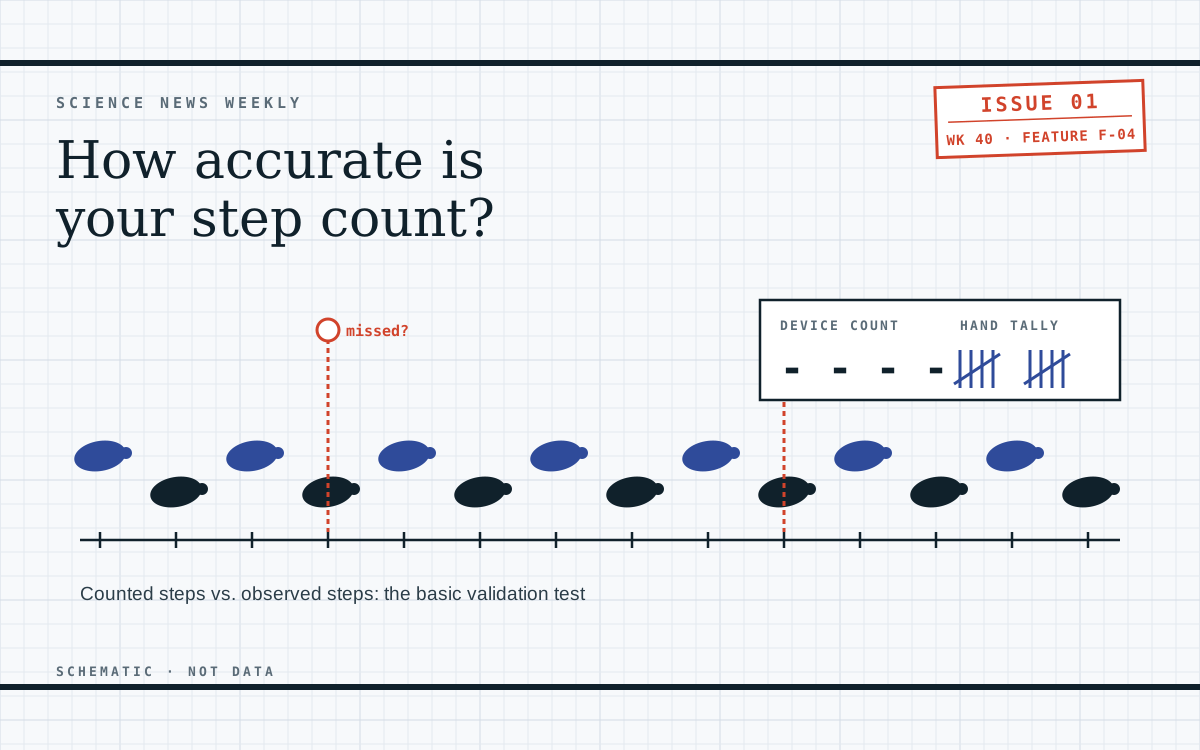
A step-count study needs a trustworthy count to compare against, and the gold standard is direct observation. In the lab, a researcher walks alongside the participant, or watches a treadmill, with a hand tally counter. Outside the lab, researchers use video: a small camera points at the participant's feet, and steps are counted from the recording afterwards.
A 2015 research letter in JAMA shows the lab version. Fourteen healthy adults walked on a treadmill at 3.0 mph for two trials each of 500 and 1,500 steps while wearing waist-worn pedometers and accelerometers, wrist-worn trackers, and two smartphones running step apps, and an observer counted steps with a tally counter [1]. Relative to the observed count, the waist devices were within −0.3% to 1.0%, the smartphone apps within −6.7% to 6.2%, and the wrist-worn devices ranged from −22.7% to −1.5% [1]. Those models are long discontinued, but the pattern (waist close, wrist wider) recurs in later work.
The free-living version is harder. In a 2018 study in Medicine & Science in Sports & Exercise, 12 adults wore a chest-mounted camera pointed at their feet during all waking hours of one day, along with 14 step-counting methods at the ankle, thigh, waist and wrists; researchers counted every step in the video with a hand tally [2]. Only the ankle-worn research monitor stayed close to the truth, at 95.3% to 102.8% of actual steps. Eleven methods, including waist clips, a thigh monitor and wrist trackers, recorded fewer steps than were taken, several in the range of 69% to 91%; some settings of a research accelerometer at the wrists and hip overcounted, recording 109% to 220% [2]. With 12 people and one day each, the study is small, but it shows how much a full day of real life can differ from a treadmill.
The CADENCE-Adults study tested 21 step-counting devices on 258 adults aged 21–85 in 5-minute treadmill bouts from 0.8 to 8.0 km/h, against directly observed steps. At normal speeds (4.0–6.4 km/h), mean absolute percentage error (MAPE) was 1% for devices at the ankle and thigh, 3% at the waist and 15% at the wrist. Across slow speeds (0.8–3.2 km/h), accuracy fell for all devices, with an average MAPE of 40%. International Journal of Behavioral Nutrition and Physical Activity, 2022 [3].
Hip, wrist, pocket: why placement matters
A step is a leg event. A device at the ankle or thigh moves with the leg itself. Those positions performed best on the treadmill in CADENCE-Adults [3], and the ankle monitor was the most accurate in the free-living video study [2]. At the waist, the device still feels each foot strike through the pelvis. At the wrist, it has to infer steps from arm swing, which does not always match what the legs are doing.
- Waist clip: close to the body's center; in the treadmill studies above, waist devices were within a few percent at normal speeds [1][3]. A clip that tilts or hangs loosely changes what the sensor sees.
- Wrist: convenient and worn all day, but more error at normal speeds in the lab (15% MAPE on average in CADENCE-Adults) [3]. Arm movement without walking can add steps; walking without arm swing can lose them.
- Pocket, bag or lanyard: the device moves partly independently of the body. Results depend on how snugly it is held, and differ from a firm clip.
One practical consequence: if you move a device from your wrist to your pocket, or switch devices, your daily totals may change even if your walking does not. Compare days measured the same way.
Slow walking and walking without arm swing
Slow walking is the best-documented weak spot. Softer foot strikes produce smaller acceleration peaks, and the firmware may not count them. In a Swiss study, 21 healthy adults walked 100 m at three metronome-controlled paces, plus 200 m at their own pace for a baseline, while wearing four consumer trackers at the waist, wrist or neck. Mean error rose from 12% at a self-selected pace to 27% at 0.8 m/s, 52% at 0.6 m/s and 76% at 0.4 m/s [4]. The authors concluded that none of the tested devices could reliably measure activity for people walking slower than 0.6 m/s (2.16 km/h) [4]. The CADENCE-Adults results point the same way, with accuracy falling across the slowest treadmill speeds for every device [3].
Walking with the arms still, such as pushing a shopping cart or stroller, or holding a handrail, is a particular question for wrist devices, since the wrist barely swings. We did not find a study that quantified this for current consumer models, so it is worth checking on your own device with the procedure below.
A 100-step and 500-step self-check
This check tells you how your device counts for your body and your usual placement. It follows the logic of the lab studies: a counted reference against the device. It does not calibrate anything.
Note the starting number
Write down the device's step total (or reset it, if it allows). Wear it exactly as you normally do.
Walk 100 steps and count them
Walk at your normal pace on a flat, uninterrupted route, counting every step aloud or with a tally counter. Avoid starting and stopping, since some devices only begin counting after a run of consecutive steps.
Work out the difference
Subtract the starting number from the new total to get the device count. The percentage difference is (device count − counted steps) ÷ counted steps × 100. A count of 96 for 100 real steps is −4%.
Repeat with 500 steps
A longer walk reduces the effect of the start threshold and gives a steadier figure. Repeat it two or three times and look at the range.
Test the conditions you care about
Walk 100 steps slowly, then 100 steps pushing a cart or holding a bag in the hand on the device's side. These are the conditions where studies and manuals suggest counts drift, and your own numbers tell you by how much.
A few percent either way at a normal pace is in line with what well-placed devices achieved in the laboratory studies above. A consistent large undercount or overcount is useful to know too: it tells you to read your totals with that offset in mind, or to try a different placement.
What the count is for
The Physical Activity Guidelines for Americans (2nd edition, 2018) set their adult targets in minutes, not steps: the equivalent of 150 to 300 minutes of moderate-intensity activity a week [6]. The guidelines describe steps as an easy-to-understand measure of walking, dancing or running, and say that measuring step counts combined with goal setting and other behavioral approaches has been shown to increase physical activity. They suggest first setting a time goal for moderate or vigorous activity, such as minutes of brisk walking, and then working out how many steps that corresponds to [6].
That framing suits the evidence. A step counter does not need to match a hand tally exactly to show whether this week was more active than last week, provided you wear it the same way each day. The INTERLIVE Network's 2021 checklist for step-count validation exists precisely because different devices, placements and test conditions produce different numbers, and it asks researchers to report all three [5].
A step count is an activity estimate, and consumer gadgets are not diagnostic devices. Changes in your walking, pain while walking, or a drop in how far you can comfortably go are things to discuss with a clinician, not to judge from a step total.
Sources
- JAMA, 2015. Research letter comparing smartphone apps and waist- and wrist-worn devices with observer-counted steps in 14 adults during treadmill walking. PubMed 25668268
- Medicine & Science in Sports & Exercise, 2018. Video-recorded validation of 14 step-counting methods under free-living conditions in 12 adults over all waking hours of one day. PubMed 29381649
- International Journal of Behavioral Nutrition and Physical Activity, 2022. CADENCE-Adults: validity indices for 21 step-counting devices by treadmill speed, wear location and age group in 258 adults. PubMed 36076265
- Journal of Medical Internet Research, 2016. Influence of position (waist, wrist, neck) on the accuracy of four consumer step counters at slow walking speeds in 21 adults. PubMed 27713114
- British Journal of Sports Medicine, 2021. INTERLIVE Network expert statement and checklist for determining the validity of consumer wearable and smartphone step counts. PubMed 33361276
- U.S. Department of Health and Human Services. Physical Activity Guidelines for Americans, 2nd edition (2018), including Appendix 1 on steps. health.gov (PDF)
This feature is educational and is not medical advice. Consumer wellness gadgets are not diagnostic devices. If a reading worries you, or you have symptoms, talk to a qualified clinician.