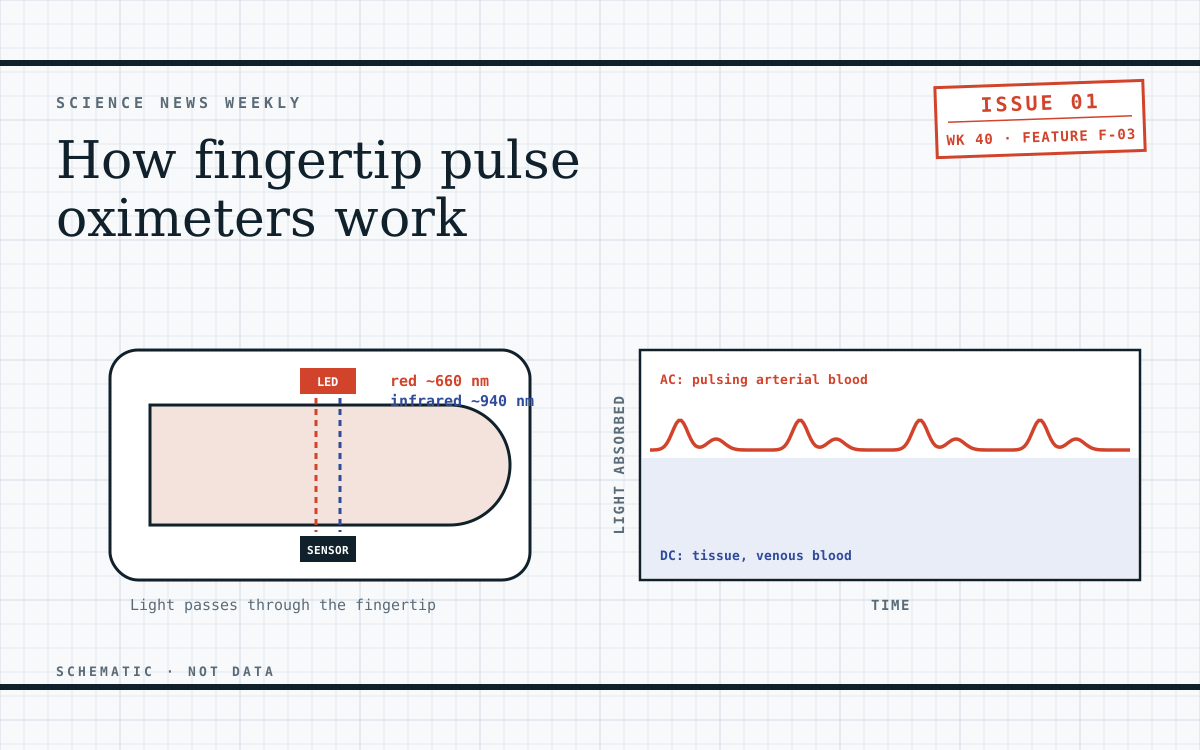
A pulse oximeter reports two numbers: SpO2, an estimate of the percentage of hemoglobin in arterial blood that is carrying oxygen, and pulse rate. It gets both without a needle, by measuring light. Pulse oximeters are used routinely in hospitals and doctors' offices, and they also have known limits that the FDA has written about at length. Both halves of that sentence matter for anyone buying one.
Two colors of light and a pulse
The FDA's own technical summary for its 2022 advisory committee meeting describes pulse oximetry as resting on two physical facts [2]. First, arterial blood arrives in pulses, so the amount of blood in the fingertip rises and falls with each heartbeat. Second, oxygenated and deoxygenated hemoglobin absorb light differently. In the red and infrared regions, typically 660 nm and 940 nm, oxygenated hemoglobin absorbs more infrared light and lets more red light through, while deoxygenated hemoglobin does the opposite [2].
A fingertip oximeter places LEDs on one side of the finger and a light sensor on the other. The light that reaches the sensor has two parts. A steady part comes from skin, bone, tissue and venous blood. A small pulsing part comes from the arterial blood surging in with each beat. The device isolates the pulsing part at both wavelengths, computes the ratio of red to infrared, and converts that ratio into an SpO2 percentage [2]. The timing of the pulses gives the pulse rate.
Two design details follow. A clip that shines light through the finger is called a transmittance sensor; a watch that shines light into the wrist and measures what bounces back is a reflectance sensor. And because the SpO2 a device displays is checked against blood samples from real people, who was in those tests matters, as the sections below explain.
The accuracy number: Arms
The accuracy figure in an oximeter manual is usually given as Arms, the root-mean-square difference between the device's SpO2 and a reference arterial saturation (SaO2) measured in blood samples by a laboratory co-oximeter. It combines systematic offset and scatter into one number. The FDA's summary gives a plain reading of it: if Arms is 3%, the probability that an SpO2 value is within 3 percentage points of the arterial value is roughly 68% [2]. In other words, about two readings in three land inside that band, and about one in three land outside it.
The FDA's 2013 guidance for prescription pulse-oximeter 510(k) submissions lists a typical Arms of 3.0% or less for transmittance, wrap and clip sensors, and 3.5% or less for ear-clip and reflectance sensors, over an SpO2 range of 70–100% [3]. The usual test is a controlled desaturation study, in which healthy volunteers' arterial saturation is brought down through supervised plateaus between 100% and 70% while the oximeter's readings are compared with arterial blood samples [6]. The 2013 guidance calls for 10 or more healthy subjects varying in age and sex, 200 or more paired data points, and a range of skin pigmentations including at least 2 darkly pigmented subjects or 15% of the subject pool, whichever is larger [3].
The FDA 510(k) summary for the Nonin Model 3250 over-the-counter oximeter (K211498, cleared November 13, 2024) reports two controlled desaturation studies run on Nonin's Model 9590, which the filing says shares the 3250's optical path and algorithm. An independent study with 34 participants of diverse skin pigmentation reported an overall Arms of 2 across 70–100% SaO2; an internal study conducted at the University of California, San Francisco, with 26 participants reported 2.27. Pigmentation was assessed by perceived Fitzpatrick scale, Monk scale (second study) and a spectrophotometer measure called the individual typology angle. This is manufacturer data from a regulatory filing. FDA 510(k) summary K211498, 2024 [6].
What can throw a reading off
The FDA's consumer page on pulse oximeters, updated in March 2025, lists factors that can affect the accuracy of a reading: poor circulation, skin pigmentation, skin thickness, skin temperature, current tobacco use, and fingernail polish [1]. The agency's 2022 technical summary adds ambient light, motion, dyes and low perfusion, meaning reduced blood flow at the sensor site, which weakens the pulsing signal the device depends on [2].
Skin pigmentation has received the most attention. The FDA's summary explains why it is considered the most likely cause of differences for optical devices: epidermal melanin absorbs light strongly, and differently at different wavelengths [2]. If the people in accuracy tests do not span the full range of skin tones, a device's error for some users can go unmeasured. A widely cited 2020 letter in The New England Journal of Medicine analyzed two hospital datasets of adults whose oximeter readings were paired with arterial blood samples taken within 10 minutes. Among paired readings where the oximeter showed 92–96%, arterial saturation was below 88% in 11.7% of measurements from Black patients versus 3.6% from White patients in the single-center dataset, and 17.0% versus 6.2% in the multicenter dataset [7]. Those were hospital oximeters used in routine care, not a controlled test of any consumer model, but the finding helped prompt the FDA's review.
The FDA's current position is measured: it says current scientific evidence suggests there are some accuracy differences in pulse-oximeter performance between individuals with lighter and darker skin pigmentation [1].
The FDA's 2025 draft guidance
On January 6, 2025, the FDA published a draft guidance titled “Pulse Oximeters for Medical Purposes – Non-Clinical and Clinical Performance Testing, Labeling, and Premarket Submission Recommendations” (docket FDA-2023-N-4976) [4][5]. The agency's announcement listed its key elements [5]:
- Clinical data, such as a controlled desaturation laboratory study or, in certain cases, real-world data, to evaluate accuracy across the range of skin pigmentations.
- More clinical study participants.
- Both a subjective skin-tone scale (the Monk Skin Tone Scale) and an objective measurement (the individual typology angle) to describe participants.
- A prominent labeling statement when a device has shown in a new submission that it performs comparably across groups with diverse skin pigmentation and is intended for medical purposes.
Two cautions about this document. It is a draft: as of Sep 30, 2026, the FDA's guidance page still lists it as a draft, which means non-binding recommendations not yet in force [4]. And it applies to pulse oximeters for medical purposes; the FDA notes that many oximeters sold over the counter or for sport and aviation are general wellness products that the agency has not evaluated [5].
Prescription, cleared OTC, and wellness SpO2
The same letters, SpO2, appear on three very different kinds of product.
- Prescription oximeters are cleared by the FDA through the 510(k) process and used mainly in hospitals and clinics, where they are used for trending or spot-checking oxygen saturation to support clinical decisions [1].
- Cleared over-the-counter oximeters are a newer, small category. The FDA's 2022 summary stated that it had not yet cleared any OTC pulse oximeter for medical purposes [2]; its 2025 consumer page says a small number are now available over the counter following clearance [1]. A query of the FDA's 510(k) data for the OTC oximeter product code (OLK) on Sep 30, 2026 returned two clearances: the Masimo MightySat OTC (K214115, January 31, 2024) and the Nonin Model 3250 (K211498, November 13, 2024) [8]. The Nonin is logged in our cabinet as the Nonin TruO2.
- General wellness and sport or aviation oximeters, which include most inexpensive fingertip clips and the SpO2 feature in watches and rings, are not reviewed or evaluated by the FDA before sale [1]. The FDA's January 2026 general wellness guidance gives as an example a portable product intended to monitor pulse rate or oxygen saturation during exercise and hiking [9]. The guidance also says that a product's inclusion under the wellness policy does not establish that it has been shown to be safe or effective for its intended use [9].
Watch SpO2 has a further handicap: it is a reflectance reading taken at the wrist, where the pulsing signal is weaker and the wearer is rarely still. Our Amazfit Bip 6 entry found no published validation of blood-oxygen readings for any Amazfit watch, and describes the watch's figure as a wellness estimate, not an oximeter reading.
Taking a cleaner reading
The FDA's consumer guidance describes how to get the best reading from a fingertip device at home [1]. These steps reduce avoidable error; they do not change the device's stated accuracy.
Read the manual first
Follow the manufacturer's instructions for use; the manual says how the clip should sit on the finger.
Warm, relaxed hand below the heart
Place the oximeter on a finger of a warm, relaxed hand held below the level of the heart. Cold fingers reduce blood flow at the sensor.
Remove nail polish
Take off any fingernail polish on the finger you are using; it sits directly in the light path.
Sit still
Do not move the hand or finger wearing the oximeter while it measures.
Wait for one steady number
Wait a few seconds until the reading stops changing and displays one steady number, then write down the value with the date and time so you can see changes over time.
Every oximeter reading is an estimate with an error band, and a consumer gadget is not a diagnostic device. The FDA advises considering readings together with how you feel, and contacting a health care provider if you are concerned about a reading [1]. A wellness SpO2 figure from a watch or an unreviewed clip should never be the basis for a medical decision. If a reading worries you, talk to a clinician.
Sources
- U.S. Food and Drug Administration. Pulse Oximeter Basics (Consumer Update), content current as of March 26, 2025. fda.gov
- U.S. Food and Drug Administration. FDA Executive Summary: Review of Pulse Oximeters and Factors that can Impact their Accuracy, prepared for the November 1, 2022 Anesthesiology Devices Advisory Committee meeting. fda.gov (PDF)
- U.S. Food and Drug Administration. Pulse Oximeters – Premarket Notification Submissions [510(k)s]: Guidance for Industry and FDA Staff, issued March 4, 2013. fda.gov (PDF)
- U.S. Food and Drug Administration. Pulse Oximeters for Medical Purposes – Non-Clinical and Clinical Performance Testing, Labeling, and Premarket Submission Recommendations (draft guidance, January 2025; docket FDA-2023-N-4976). fda.gov
- U.S. Food and Drug Administration. FDA Proposes Updated Recommendations to Help Improve Performance of Pulse Oximeters Across Skin Tones (news release), January 6, 2025. fda.gov
- U.S. Food and Drug Administration. 510(k) clearance letter and summary, K211498, Nonin OTC Pulse Oximeter Model 3250, 2024. accessdata.fda.gov (PDF)
- The New England Journal of Medicine, 2020. Correspondence analyzing pulse-oximeter readings paired with arterial blood-gas measurements in two hospital datasets, by patient race. PubMed 33326721
- U.S. Food and Drug Administration, openFDA. 510(k) records for product code OLK (pulse oximeter for over-the-counter use), queried Sep 30, 2026. api.fda.gov
- U.S. Food and Drug Administration. General Wellness: Policy for Low Risk Devices, guidance issued January 6, 2026. fda.gov (PDF)
This feature is educational and is not medical advice. Consumer wellness gadgets are not diagnostic devices. If a reading worries you, or you have symptoms, talk to a qualified clinician.